

Gaslight!
An Origin Story

Where to Begin?
When you begin directing a play, You start with context. You start by asking: What’s the origin story?
What is the history of the work? What about the playwright — or in this case, playwrights? What was the world doing when this story first flickered to life? And maybe most importantly: how has it interacted with the world since its inception?
As I prepare to direct Gaslight at PURE Theatre, and the archaeology of this particular play is as darkly fascinating as the play itself. This coupled with Steven Dietz deeply psychological and intricate adaption makes for the kinds of rabbit holes that I adore.
(Check out Steven Dietz article on Revision HERE.)
A Word That Became a Tool of Defense
Most people know the term “gaslighting.” It’s become so embedded in our cultural vocabulary — shorthand for a specific kind of psychological manipulation — that it’s easy to forget it came from somewhere. It came from here. From a play. From a playwright named Patrick Hamilton.
Hamilton wrote Gas Light in 1938, a taut domestic thriller about a husband who systematically dismantles his wife’s grip on reality — dimming the gas lights in their home and then insisting she’s imagining things when she notices. It’s a deceptively simple mechanism that exposes something deeply unsettling about intimate power and the architecture of control.
The Film That Got Gaslighted
Here’s where the history gets complicated — and a little ugly.
The play was first adapted into a British film in 1940, a lean, atmospheric piece of work that did exactly what it needed to do. Then Hollywood came calling. MGM produced their own version in 1944 — bigger, bolder, star-filled, with Ingrid Bergman and Charles Boyer — and it became the definitive screen adaptation. Bergman won the Academy Award. The film entered the canon.
But here’s the thing: MGM reportedly sought to have all existing prints of the original British film destroyed, so that their version would stand alone and unchallenged. Think about that for a moment. The studio behind the Gaslightremake attempted to erase the original from existence — to make audiences doubt it had ever been there at all.
The original film was, quite literally, gaslighted.
Ah, Hollywood. In my film classes I’m blessed with an amazing array of content creators out there. The short documentary below is from In/Frame/Out. Check out the channel if you enjoy it.
Here’s the trailer for the MGM production.
And for the bold the complete original production. The cinematic techniques in the opening are stunning.
Why Context Matters
Every play carries its history in its bones. The choices Hamilton made in 1938 weren’t abstract — they emerged from a world where domestic tyranny was largely invisible, where a woman questioning her own perceptions had no cultural framework to name what was being done to her. Hamilton gave us that framework. He gave us the word.
And now, nearly ninety years later, in a world where that word has become common currency, the play hits differently. The audience walks in already knowing what gaslighting means. The question becomes: does that knowledge protect them from the experience of watching it happen — or does it make the watching even more unbearable? The play that Steven Dietz has crafted speaks so eloquently to this modern feeling. Gaslight becomes not simply a call back, but an evolution of the human experience.
That’s the territory I’m exploring. More to come as rehearsals begin.
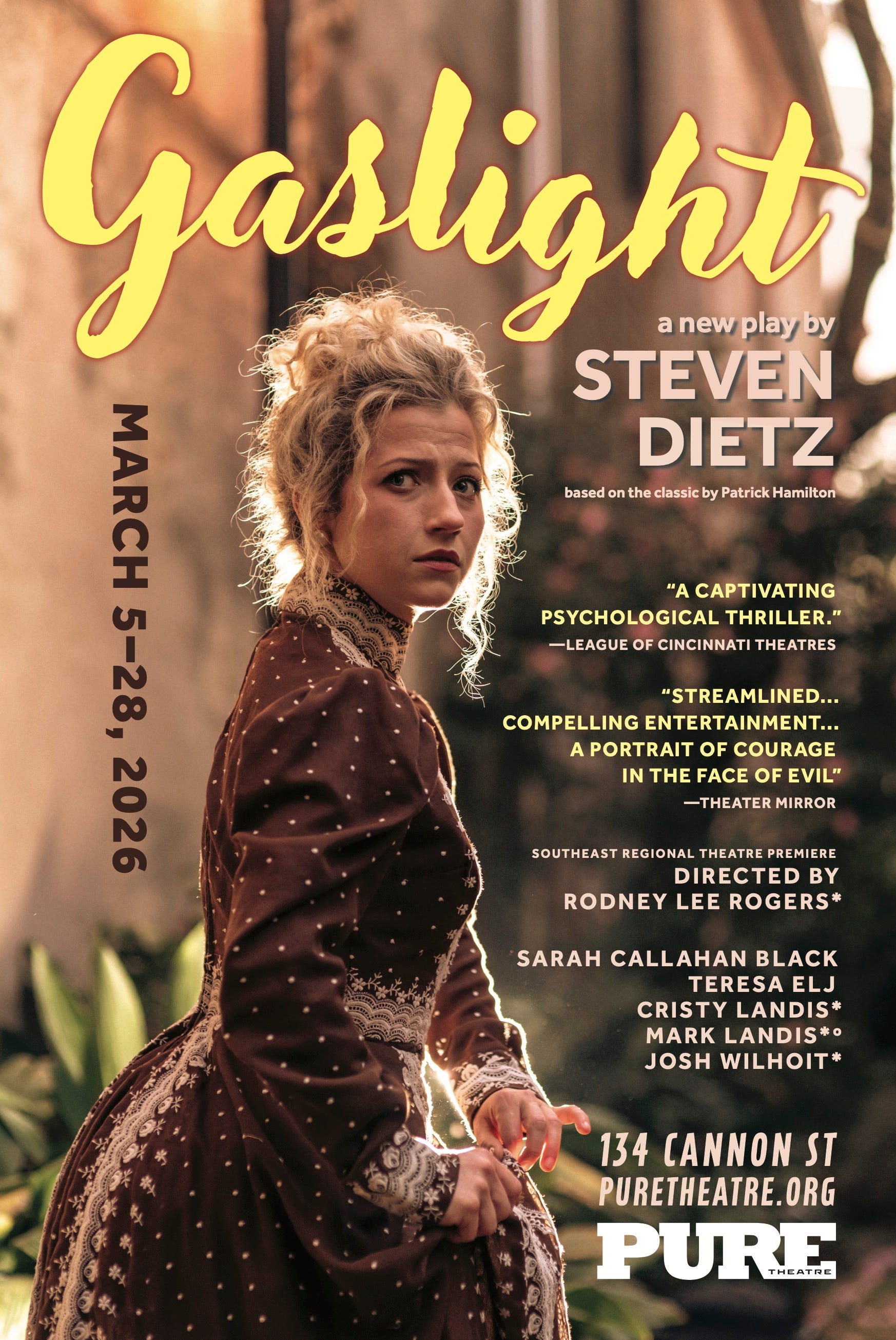
Gaslight opens at PURE Theatre on March 5th. MORE INFO AND TICKETS
What Rodney is touching on here is honestly one of my favorite parts of our work.
When theatre is doing what it’s meant to do, it pulls us closer to the world we’re actually living in. One play opens into history, psychology, politics, language, memory. You follow a thread, and suddenly you’re down a rabbit hole you didn’t even know you needed. It's the digging that sparks curiosity, feeds it, and enriches lives.
That’s what PURE has always been about. Engagement. Living this life as fully as we can.
I’d love for you to go there with us.